

What makes a film “queer”? Is it explicit representation? Queer characters… even if we don’t focus on their sexuality? Or simply a strong suspicion that it was made for us?
Forbidden Fruits sits in a hazy grey area where the queerness of the film is fully up for debate. So, let’s talk about it.
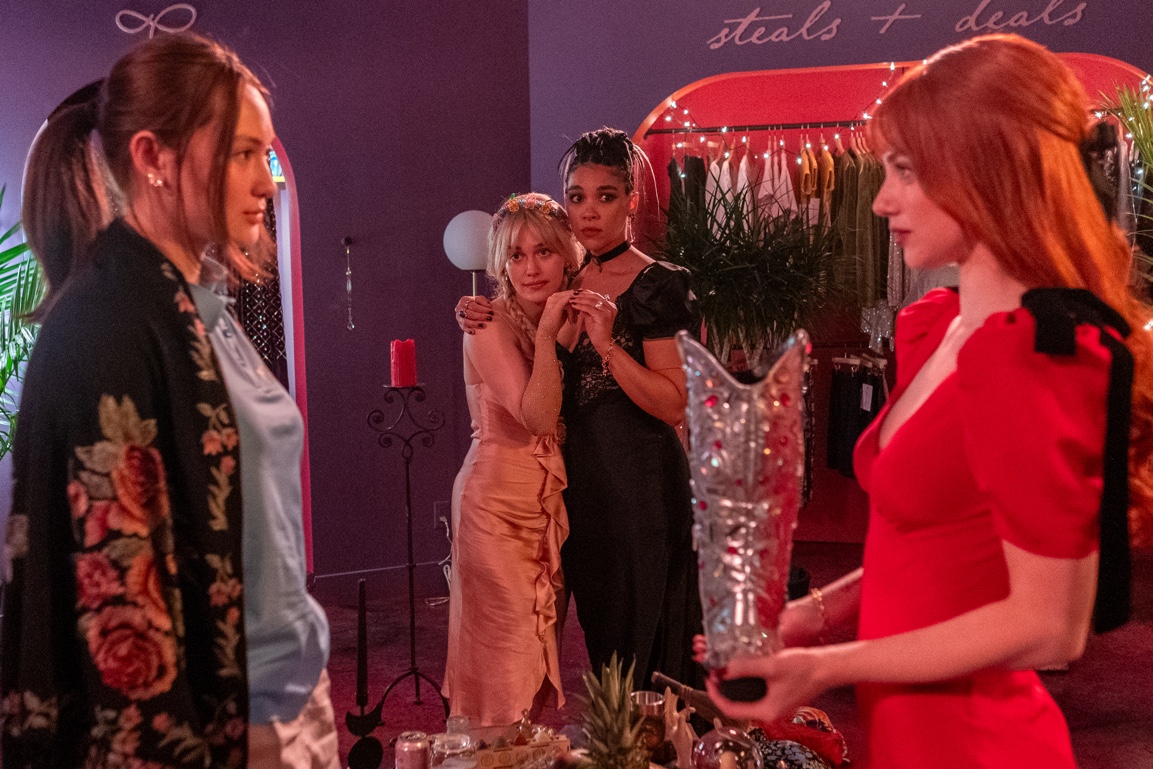
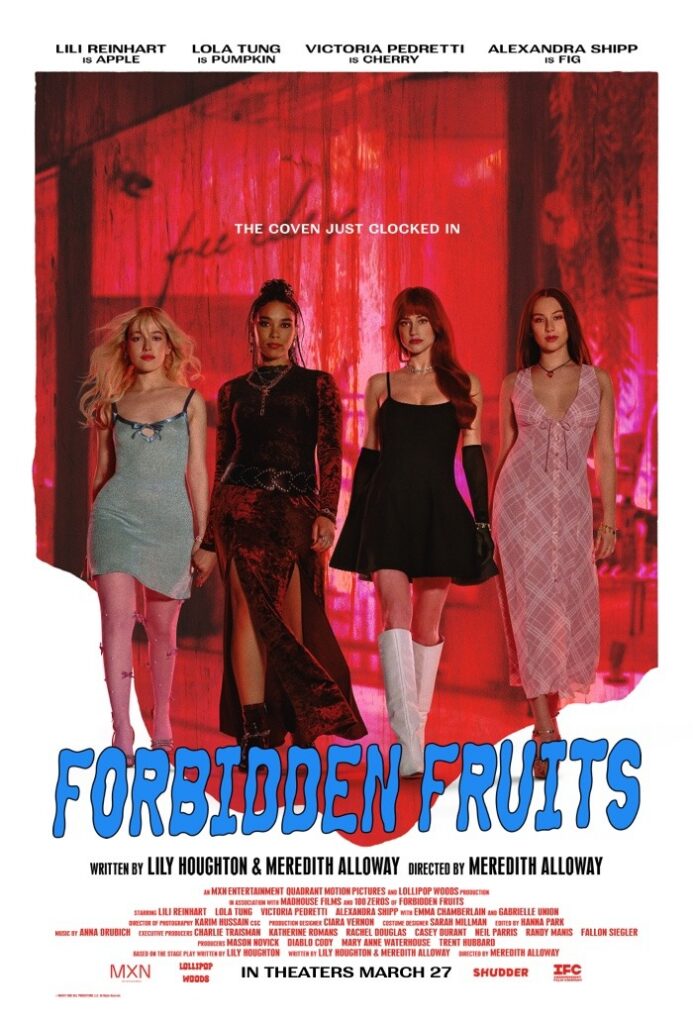
If you haven’t yet heard of this new horror flick, Forbidden Fruits focuses on a coven of four women who work at a high-end mall store, slinging trendy fashion by day and working their culty magic by night. To the rest of the mall community—shoppers and staff—the women are reverently referred to as “The Fruits.” Lili Reinhart plays alluring coven leader Apple, Victoria Pedretti is flawlessly ditzy as Cherry, Alexandra Shipp keeps audiences laughing as Fig, and Lola Tung stirs the pot as coven newcomer Pumpkin.
While none of the characters explicitly state that they are LGBTQ+, none of them explicitly state that they aren’t, and the film is subtly queer coded. But is that enough?
🚨🚨🚨Light spoilers to follow. If you haven’t watched the film yet, consider saving this article until after you see it!🚨🚨🚨
There’s something about Apple
In the opening sequence, the camera reveals that Apple has two short nails—the pointer and middle finger—amongst her red cat eye talons. Lovingly referred to by sapphics as “vampire nails,” this “if you know you know” manicure style seems to be a wink to those who understand the desire to get down and dirty with a woman without hurting her body.
Reinhart, who came out as bisexual in 2020, said in a video on TikTok that she explicitly requested that Apple have the two short nails. In a separate video, she also stated that she consistently pushes for her characters to canonically identify as lesbians or bisexual women. With all of this intel, it seems safe to assume that Apple is sapphic in some way.
Apple’s queer desire feels even louder when we see the intensity of her relationships with the other fruits. It’s practically a sapphic rite of passage to have an intense, toxic, somewhat homo-erotic friendship with a girl friend at some point. Apple manages to have multiple, but her relationship with Cherry is the most excessive. Apple controls Cherry’s schedule and actively shapes her personality, even dictating who she talks to and how. Eventually Cherry reveals that Apple doesn’t like Cherry to have sex.
So it’s not surprising that at the film’s climax, it comes out that Cherry is one of the only people to know Apple’s big secret. As Cherry threatens to share what she knows, Apple feels her grasp on Cherry start to slip. In response, Apple kisses her. Is this a vulnerable attempt on Apple’s part to grow their friendship into something more intimate or simply a tactic to seduce and regain control? Apple’s a complex and deeply flawed woman, so it’s hard to tell.
It’s also worth noting that Apple openly hates men, so much so that she refuses to have children because of the risk of birthing to a boy. At first glance, lines like this might infer Apple is the stereotype of a man-hating lesbian, however the plot gives Apple a clear backstory (completely separated from her sexuality) that explains why her idea of utopia is a world run by women. For Apple men cause trauma, they cause pain, and she can’t seem to find any other reason to keep them around.
© 2026 IFC Films.)
Cuntiness on full blast
It’s hard to talk about serving cunt because it’s such a vibe. However, the characters of Forbidden Fruits have cuntiness down to an art. The fruits are bitchy and audacious in what they say, but their cuntiness is most clear in how they dress and move through the world.
The Fruits work at the most elite of mall stores—the fictional Free Eden (clearly based on Free People)—meaning fashion plays a major role in this film. The coven struts through the mall in stiletto heels and micro shorts like they’re working a Fashion Week runway. Their every move is a calculated performance of hyper femininity. As the audience, we are treated to swaying hips and satisfying heel clacks perfectly synced to rebel-girl music.
During their magical gatherings, the fruits don veils and flowy drapey dresses, revealing cleavage, thighs, and curves. They give off a confident, effervescent energy, as if they could claw anyone’s eyes out and look smokin’ hot while doing so. In the rare moments when the women aren’t feeling their best, they continue to dress to serve, determined to reflect their place at the very top of the mall hierarchy.
© 2026 IFC Films.)
Camp as the final ingredient
If Forbidden Fruits provides cuntiness in what we see, its camp comes through in what we hear.
Forbidden Fruits is full of ridiculous lines delivered with full sincerity, giving the film a hilarious and light-hearted sarcasm despite its more horror-themed elements. A personal favorite would be the incantation Apple, Cherry, and Fig use to initiate Pumpkin into the coven: “Goat’s milk, thigh gaps, rose petals, bone cast, truffle oil, bitch slap, blood clots, juice prep.” The weaving of pop culture and witchy terminology doesn’t really make sense, but the reverence with which the coven chants it catapults it into the realm of delightfully absurd.
An interaction particularly appreciated by the audience I saw the film with was Fig’s genuine response of “FOMO!” to learning that the rest of the coven was part of the Dead Dad’s Club. Fig’s reaction is outrageous and inappropriate, but the earnestness of Shipp’s delivery makes this bizarre moment wildly funny.
This moment with Fig reveals early on that this is a film about the desire to fit in, to be seen, and to be understood. Meredith Alloway and Lily Houghton’s screenplay takes that very real experience and pushes the boundaries of reality. This type of satire has always been a safe haven for camp. Who could forget feeling intimately seen while simultaneously cackling to the over-the-top conversion tactics of But I’m a Cheerleader?
Taking a heavy topic and pushing it to the point of absurdity allows us a chance to discuss with levity. We see the problem, we recognize how unhinged it is, and we caricaturize it to explore it further. That is the art of camp.
In Forbidden Fruits this absurdity flows continuously through sharp writing, talented delivery, and visionary direction, giving it an edge that holds its own in the world of queer camp.
…But does that make it queer cinema?
Forbidden Fruits is cunty, it’s camp, it stars a bisexual actress as a sapphic witch, but does that make it a queer film?
It depends on what you look for in your queer movies. If you’re looking for explicitly positive representation of LGBTQ+ folks then, no, I don’t think you can call Forbidden Fruits a queer film. Apple’s sexuality is communicated through subtle looks, fleeting actions, and the ability to understand subtle nods to queerness. There’s no LGBTQ+ love story or mention of the community. This isn’t a movie designed to provide the representation necessary to push LGBTQ+ acceptance forward in society.
However, it is a fun and irreverent movie with a decidedly queer vibe. If you consider anything that contains obvious elements of queer culture as queer media, then you might consider Forbidden Fruits a queer film. Some of the references and experiences the characters depict—like Apple’s obsessiveness and control of her friends as indications of toxic sapphic yearning—feel like a covert wink from the filmmakers. Almost as if to say, “the girls who get it, get it” to the queer audience members watching.
This is where I tend to lean, considering Forbidden Fruits on par with campy queer flicks like The Rocky Horror Picture Show and Bodies, Bodies, Bodies. But, ultimately, it’s up to each viewer to decide for themselves: Do you see Forbidden Fruits a queer film or simply a campy horror movie?